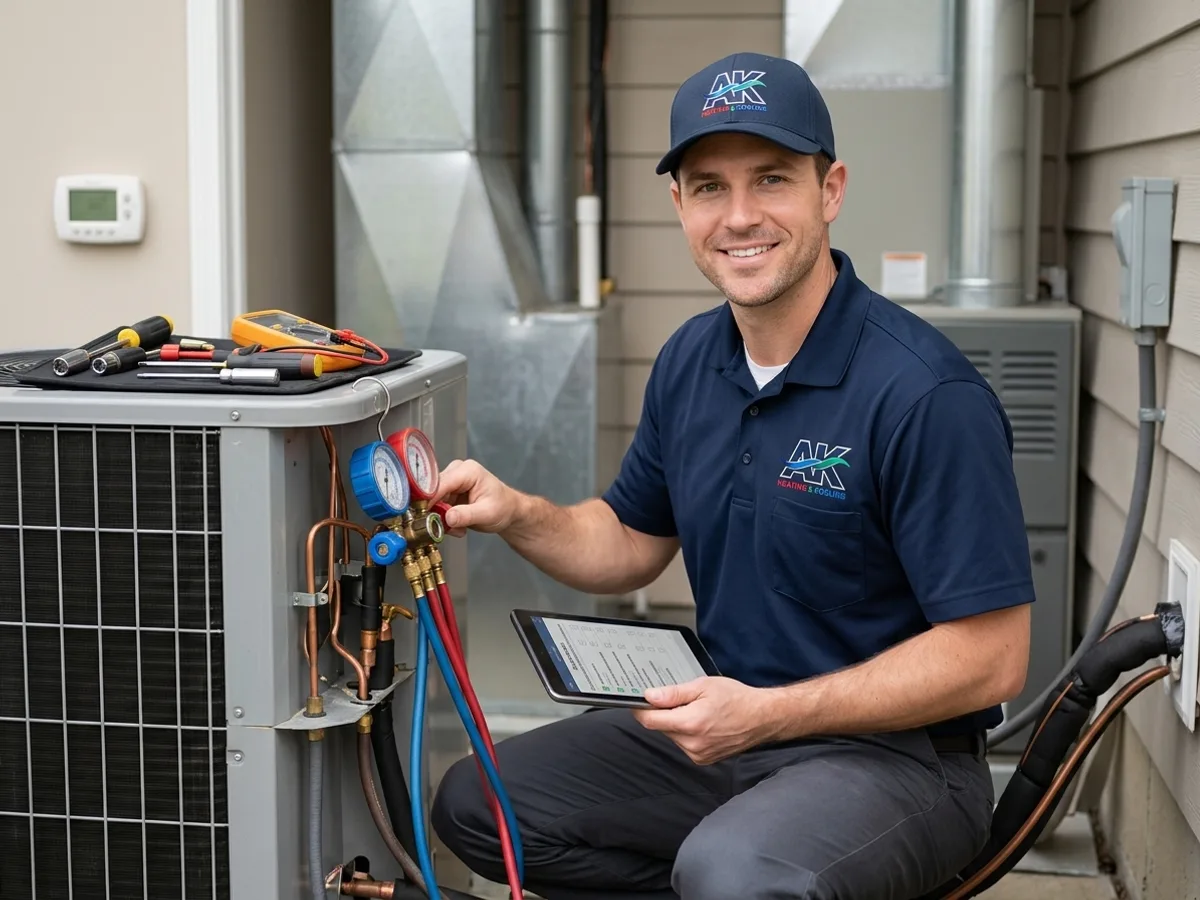
Real readings, not 'looks fine'
Capacitor microfarad meter, manifold gauges, combustion analyzer, amp clamp. Numbers against rated values. That's how you catch the failure two months before it happens, not after.
Spring AC tune-up, fall furnace tune-up. Real multi-point precision service - not a quick walk-around. Catches the cheap fix in April so it doesn't become an emergency call in July. Across Trumbull, Mahoning, Portage, Ashtabula, and Columbiana counties.
Regularly $119 · Appointments are limited
Our technician inspects and tests your heating system before the cold weather hits. Carbon monoxide safety check included. No membership required.
$59 fall furnace tune-up for residential customers, for a limited time and while appointments last. No membership required. Repair costs, if needed, are separate.
Unmaintained residential HVAC loses roughly 5% efficiency every year and dies 4-6 years before its rated life. That's compounding interest working against you, billed monthly to your gas and electric account, on top of an early replacement bill. The cost of skipping tune-ups is invisible until the day the AC quits at 88 degrees indoor or the furnace locks out on the first 20-degree night.
Two visits a year is the standard cadence: spring AC tune-up before peak summer load, fall furnace tune-up before the first hard freeze. Each visit is a real multi-point inspection - capacitor microfarad readings, refrigerant pressures, combustion analysis on the gas side, heat exchanger inspection, coil clean, condensate clear, electrical and thermostat checks. The point isn't to upsell you on repairs - it's to find the cheap fix in April when parts are on the truck and slots are available, before it becomes an emergency call in July at after-hours rates.
There's a second reason maintenance matters that most homeowners don't know about: most manufacturer warranties require documented annual maintenance to stay valid. Carrier, Trane, Lennox, Goodman, Rheem - they all do. Skip the tune-ups and you risk having a 10-year parts warranty denied when the compressor fails in year seven. We keep your service records on file specifically for warranty documentation.
Two visits per year - spring AC, fall furnace. Heat pumps and ductless systems get checked in both modes during those visits. Every visit ends with a written condition report.
Most residential maintenance visits run 45-75 minutes per system, depending on equipment age and condition. Heat pumps and dual-fuel hybrids run longer because there's more to check.
Spring AC: April through early June. Fall furnace: September through early October. These are the easy-booking windows. Once peak summer or winter demand hits, slots compete with emergency calls and wait times stretch into weeks.
Tech runs the full inspection on whichever system is in season - capacitor microfarads, refrigerant pressures, coil clean on AC; heat exchanger, combustion analysis, gas pressure, flame sensor on furnace. Real readings against rated values, not a 'looks good' walk-around.
Condenser coil garden-hose wash (cottonwood season alone can cost 10-15% efficiency), evaporator visual, condensate line cleared if biofilm has built up, flame sensor cleaned, burners inspected. The cleaning is half the value of a tune-up.
Written condition report with what we did, what readings we got, and what we noticed. Anything that's a 'fine for now but watch it' gets a rough timeline (e.g., 'capacitor reading 88% of rated, expect to replace within 2 seasons'). Anything that's a safety issue (cracked heat exchanger, refrigerant leak, electrical hazard) gets flagged immediately.
Service records stored on file. If you ever need to file a manufacturer warranty claim, we provide documented proof of regular maintenance - which is what keeps the 10-year parts warranty valid on most major brands.
Half the 'tune-ups' in NE Ohio are sales pretexts. Here's what makes ours actually maintenance:
Capacitor microfarad meter, manifold gauges, combustion analyzer, amp clamp. Numbers against rated values. That's how you catch the failure two months before it happens, not after.
Nobody is sent out to walk your unit and write a four-figure repair invoice on a healthy system. Our tune-ups start at $89 and members of the AKHC Maintenance Plan pay less. The point of the visit is maintenance - not upselling.
Most manufacturer warranties require documented annual maintenance to stay valid. Customers who DIY or skip years get denied on warranty claims that could have been covered. We keep your service records on file specifically so warranty work stays warrantied.
Enroll in the AKHC Maintenance Plan and get priority scheduling when emergencies hit, reduced tune-up rates, and 15% off any repair between visits. See the Maintenance Plan page for current tier pricing.
Mantalis family, Warren HQ. Same techs you'll see year after year. If something we maintained fails in normal use, you call the same number and we make it right - no escalation to a regional manager you can't reach.
Maintenance visit reveals a condensate clog flooded the basement? AK Water Works handles the plumbing side. Smelled gas during the furnace check? Same number covers it. One phone number for HVAC, plumbing, and restoration across NE Ohio.
Questions about your home? We will give you straight answers, no pressure.
Contact usMinimum twice yearly - spring AC tune-up before peak summer load, fall furnace tune-up before the first hard freeze. Heat pumps technically run year-round and rack up more hours than either, but they still operate on the same two-visit schedule because the equipment is checked in both heating and cooling modes during those visits. Ductless mini-splits do well on annual service. Skipping years compounds - unmaintained equipment loses roughly 5% efficiency per year.
Some of it, yes. Filter changes every 90 days (60 if you have pets), hosing down the outdoor condenser coil once a month from June through September, keeping vegetation 2 feet clear of the outdoor unit, and a quick visual check of the indoor unit for dust buildup. What you can't DIY: refrigerant pressure measurement, capacitor microfarad readings, combustion analysis on the furnace, heat exchanger inspection, electrical contactor inspection, flame sensor cleaning. Those need pro tools and pro eyes - and missing one of them is how a small failure becomes a $1,800 emergency repair in February.
The Big 6 AC failures (weak run capacitor, worn contactor, refrigerant drift, clogged condensate, dirty condenser coil, thermostat drift) all surface during a real tune-up before they become emergencies. On the furnace side: weak flame sensors, dirty burners, draft inducer wear, cracked heat exchangers (safety issue - CO risk), and gas pressure drift. The goal is to find the cheap fix in April before it becomes a panicked no-cool call in July at after-hours rates.
Most do, yes - and most homeowners don't know until they try to file a warranty claim and get denied. Carrier, Trane, Lennox, Goodman, Rheem, and most major brands require documented annual maintenance to keep the 10-year parts warranty valid. We keep your service records on file specifically for this - if you need to file a warranty claim, we provide documented proof of regular maintenance. Customers who skip pro tune-ups risk thousands in denied warranty work down the road.
Spring AC tune-ups: book April or early May. Once 80-degree days hit, every truck in the Valley is on no-cool emergency calls and maintenance slots get pushed weeks out. Fall furnace tune-ups: book September or early October before the first cold snap pulls people into a no-heat panic. The two-week shoulder windows in spring and fall are the easy-booking windows - everything in between competes with emergency dispatch.
Two precision tune-up visits per year (spring AC, fall furnace), priority scheduling when emergencies hit (members go to the front of the queue), reduced tune-up rates, 15% off any repair we do between visits, and warranty-grade service history kept on file for manufacturer claim documentation. See /maintenance-plan for current tier pricing.
Same-day dispatch from our Warren shop across five counties.
“Furnace went out on a Sunday night. AK had a tech in the driveway in 90 minutes, parts on the truck, and we were warm before kids' bedtime. Worth every dollar of the maintenance plan.”
“Our restaurant walk-in went down at 6am. AK answered the after-hours line on the second ring and had us running before lunch service. We've switched all of our refrigeration work to them.”
“Had Generac install, AC tune-up, and a humidifier swap done across two visits. One bill, one company, real techs. This is what local service is supposed to feel like.”

April or early May. Period. Once the first 80-degree day hits the Valley, every HVAC truck in NE Ohio is on emergency no-cool calls and your tune-up slot competes with a queue of furious homeowners with 88 degrees indoor. April is wide open, the techs aren't rushed, and you catch the weak capacitor before it strands you in July. Same logic on the furnace side - book the fall tune-up in September, not November.
Three Alex Mantalis companies, one Warren HQ. Each with its own license and insurance — coordinated when you need more than one trade.
Plumbing, Drains, Waterproofing
Visit site →HVAC, Refrigeration & Generators
You are hereFire, Water & Mold Restoration
Visit site →