My furnace turns on but isn't producing heat. What's likely wrong?
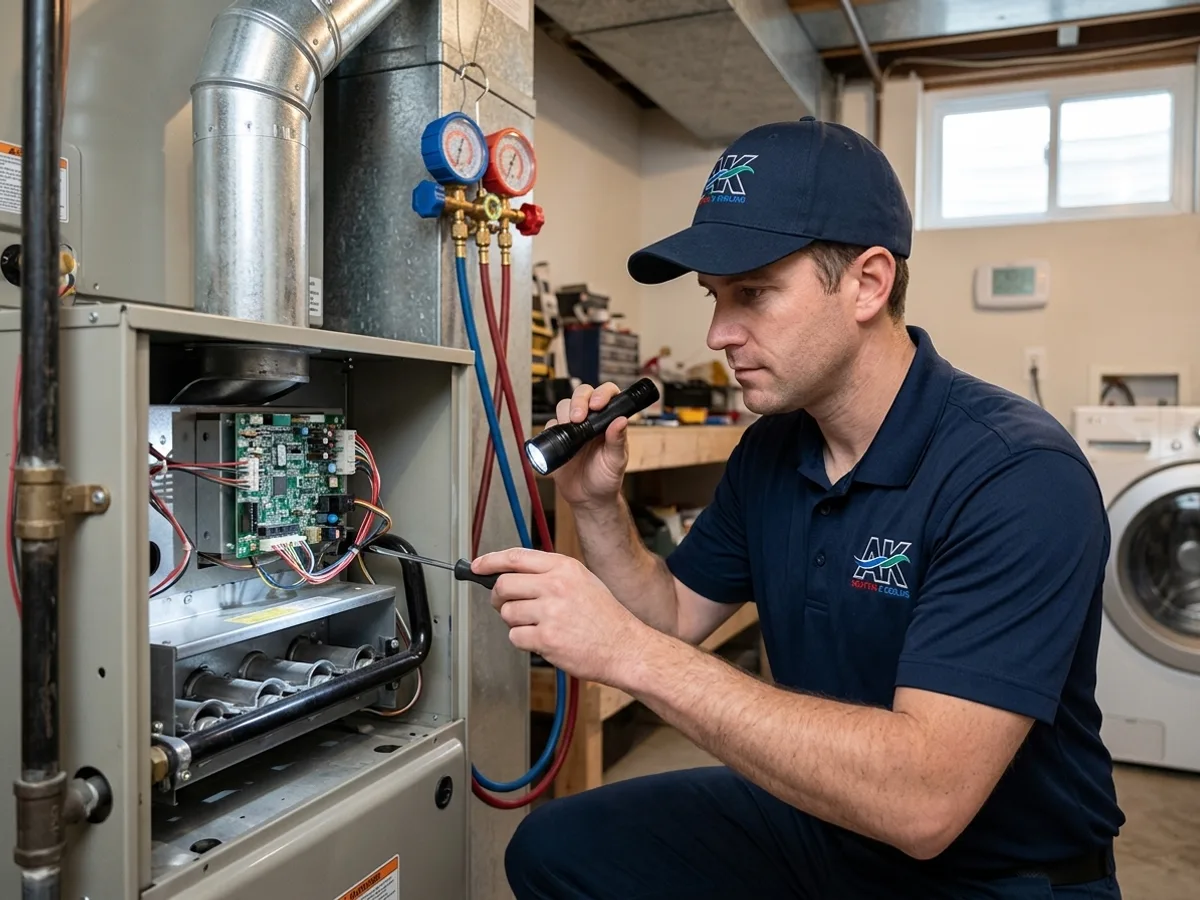
Usually one of three things. (1) The hot-surface ignitor cracked and isn't lighting the burners - you'll hear the draft inducer run, then a click, then silence. (2) The flame sensor is coated and the furnace fires for a few seconds then shuts down on safety lockout. (3) The gas valve isn't opening, often a control-board fault. Any of the three is a same-visit repair. Don't keep resetting the breaker - the lockout is telling you something.
Why does my furnace short-cycle (turn on and off rapidly)?
Short-cycling has half a dozen common causes: a dirty filter starving the airflow and tripping the limit switch, a flame sensor that drops out after a few seconds, an oversized furnace running too hot for the home, a thermostat with a bad heat anticipator setting, or a cracked heat exchanger triggering a safety. The first thing we'll check is the filter. If that isn't it, we'll work the rest of the list with the diagnostic tools.
I smell gas near my furnace. What should I do?
Get everyone out of the house. Don't flip light switches, don't use a phone inside the house, don't restart the furnace. From outside, call your gas utility's emergency line - Dominion Energy Ohio at (877) 542-2630, Enbridge Gas Ohio at (800) 344-4077, or 911. Then call us at (330) 469-6701. Gas leaks are not a same-day-when-we-get-there repair - the utility has to make the area safe first.
My carbon monoxide alarm went off. Is it my furnace?
Treat every CO alarm as real until proven otherwise. Get everyone outside, call 911 if anyone has a headache or feels dizzy, then call us. The two furnace-side causes of indoor CO are a cracked heat exchanger and a blocked or disconnected flue. Both are dangerous and both require the furnace to be shut down until the issue is verified and repaired. We run a combustion analysis on every CO-alarm service call and document the CO ppm reading at the supply registers.
My furnace is showing a flashing error code. Can you decode it?
Yes - the LED flash pattern (or the digital code on newer furnaces) maps to a specific fault on a chart inside the door panel. Common patterns: pressure switch open (flue or condensate issue), ignition lockout (hot-surface ignitor or flame sensor), limit switch open (overheating, often a filter or blower problem), or rollout switch tripped (heat-exchanger or flue issue - this one's serious). Call (330) 469-6701 with the code and we'll triage it on the phone.
My furnace is 15+ years old and the repair quote is high. Repair or replace?
Rule of thumb: if the repair runs more than half the cost of a new install and the furnace is past 15 years, replacement usually wins. If you're looking at a cracked heat exchanger, the math almost always points to replacement - heat exchanger swaps on older furnaces are rarely cost-effective and the rest of the system is on borrowed time anyway. We give you both numbers in writing - repair quote and a written replacement proposal - and let you decide. No commission pressure either way.
Do you service every furnace brand?
Yes - Carrier, Bryant, Trane, American Standard, Lennox, Goodman, Amana, Daikin, Rheem, Ruud, York, Heil, Tempstar, Day & Night, Comfortmaker, KeepRite, and most older legacy brands. Parts pipeline is established for the common-failure components on each. Older 80% AFUE units and newer 95%+ AFUE condensing furnaces both - condensing furnaces add a PVC flue, condensate drain, and pressure switch to the failure list, but our techs work them daily.
Can I get same-day service in a snowstorm or on a weekend?
Yes. We run 24/7 no-heat emergency dispatch through every NE Ohio cold snap, including holidays and lake-effect snow events. After-hours rates carry a premium but you get a real tech on the truck and parts in hand, not a callback for Monday morning. Frozen pipes are the real risk on a sub-20F night - we triage those calls to the front of the queue.