Generac authorized dealer
Factory-trained on residential and commercial lines. Parts pipeline established. Warranty work goes through us directly. Not a side-business install by a contractor who'd rather be doing something else.
From site assessment to commissioning. Permits pulled, gas line run, transfer switch wired, unit set, exercise schedule programmed - all under one contract. Across Trumbull, Mahoning, Portage, Ashtabula, and Columbiana counties.
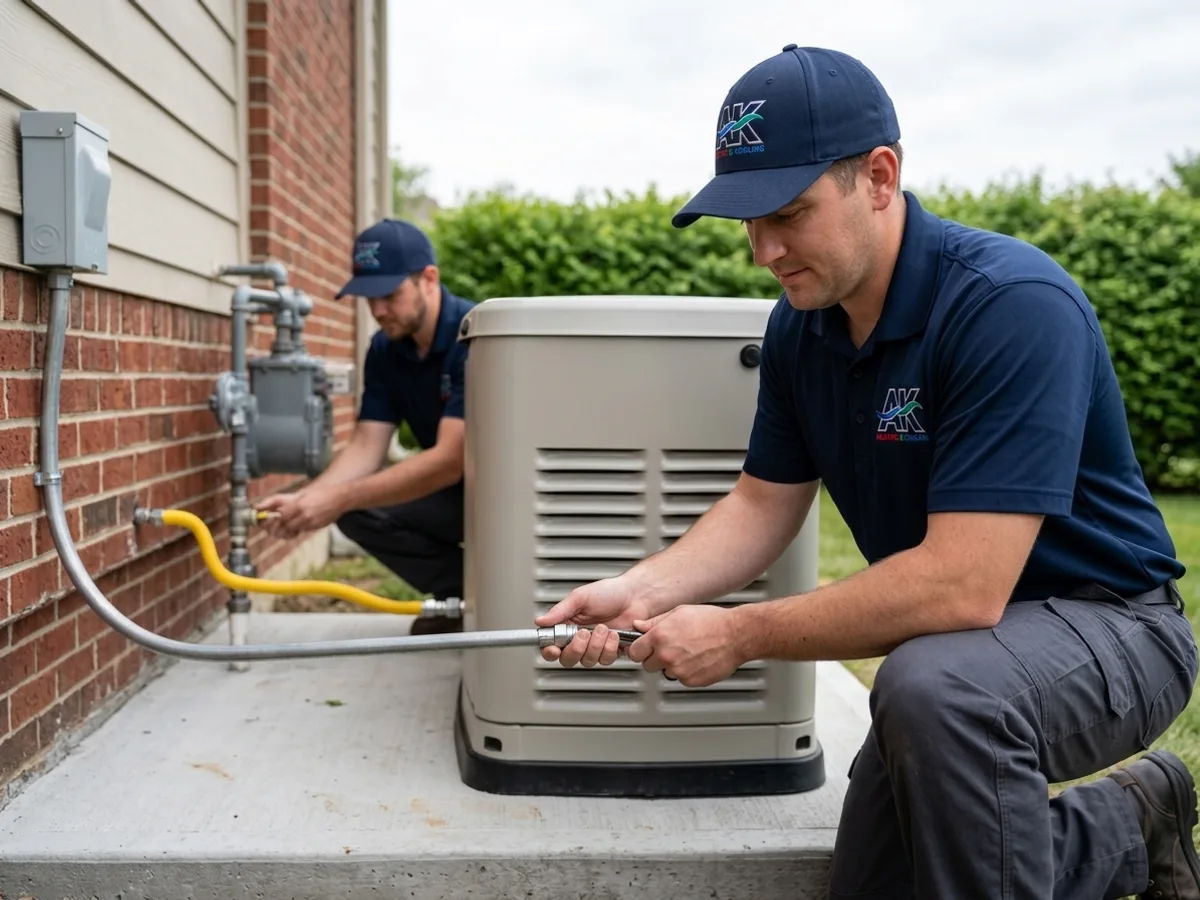
Most generator installs require three different trades: mechanical (gas appliance install and venting), electrical (transfer switch and high-voltage wiring), and sometimes structural (pad). When those three trades are subbed out across three companies, scheduling lags, accountability vanishes, and code corners get cut at the seams between trades. AKHC handles all three under one roof. Sister company AK Water Works covers plumbing if drainage or sump work overlaps.
We pull every permit ourselves through the local building department - Trumbull County, Mahoning County, City of Warren, City of Youngstown, Portage, Ashtabula, or Columbiana. We coordinate with Enbridge Gas Ohio when the gas meter needs upsizing. We schedule the inspector. You see one quote, sign one contract, talk to one company.
Every AKHC install starts with a site assessment and ends with a commissioned unit on the manufacturer warranty. Here's the full scope.
Five phases from first call to final inspection. Typical residential timeline 4 to 6 weeks - most of that is permits and utility coordination, not on-site labor.
We come out, walk your panel, check your gas service or propane setup, identify the best pad location with proper setbacks, and figure out the transfer switch route to your main panel. Load study runs in parallel - what you want to keep running drives unit sizing. 30 to 60 minutes on-site, written quote within a few days.
Mechanical, electrical, and gas permits pulled through your local building authority. If the gas meter needs upsizing, we file with Enbridge Gas Ohio and schedule that work. This phase is where most calendar lead time lives - 2 to 4 weeks typical for residential, longer for commercial.
Composite pad set (or concrete poured if required), gas line run from the meter or LP tank to the pad with proper sizing and pressure testing, rough-in electrical to the ATS location and from the pad to the ATS. Pad and gas work typically a half day to full day.
Unit set on the pad, ATS installed at the main panel, generator power wiring run, low-voltage signal wiring run, controls configured. On a standard residential install this is one day. Commercial installs with paralleled units and bus duct take longer.
Oil and coolant filled to spec, battery commissioned, initial start sequence verified, transfer test (kill utility, watch generator start and transfer, restore utility, watch transfer back), exercise schedule programmed. AHJ inspector signs off the mechanical, electrical, and gas permits. We register the 5-year limited warranty with Generac and walk you through the controls. Done.
On a $12K to $20K install you want to live with for two decades, who installs it matters more than which unit you pick. Here's what AKHC brings.
Factory-trained on residential and commercial lines. Parts pipeline established. Warranty work goes through us directly. Not a side-business install by a contractor who'd rather be doing something else.
Mechanical, electrical, and structural under one roof. No sub-contracting the gas line to an outside shop and hoping it's sized right. Sister company AK Water Works covers plumbing on the rare scope where drainage or sump work overlaps.
Mechanical, electrical, and gas permits through Trumbull, Mahoning, Portage, Ashtabula, Columbiana, or the relevant city. We schedule the inspector and own the punch list. You don't fill out a form or chase paperwork.
Most generators that start but won't carry load have an undersized gas line - this is the most common preventable install failure. We calc total connected load, length of run, and meter capacity before any pipe goes in the ground. If the meter needs upsizing, we file with Enbridge and stage the work.
Initial start, transfer test under utility kill, exercise schedule programmed for the day and time you want, controls walk-through with code-reading instructions. You leave the install knowing how to use the unit before the storm hits.
Locally owned, locally accountable. The same techs who install your unit service it for the next 20 years. Same trucks, same numbers, same accountability.
Questions about your home? We will give you straight answers, no pressure.
Contact usFrom signed contract to commissioning, typical timeline is 4 to 6 weeks for residential and 8 to 16 weeks for commercial. The actual on-site labor is usually 1 to 3 days. Most of the calendar is permit lead time, utility coordination on gas-line work, and unit-delivery lead time from Generac. We schedule everything so the physical work happens once all the pieces are in place.
Mechanical permit for the gas-fueled appliance, electrical permit for the transfer switch and generator wiring, and sometimes a separate gas permit depending on jurisdiction. Larger or commercial installs may require structural review on the pad, zoning review for setbacks, and noise-ordinance verification. AKHC pulls every permit ourselves and handles all inspector coordination - you don't fill out paperwork.
Often yes. A Generac 22kW pulls about 300 cubic feet of natural gas per hour. That needs a 1.25 to 2-inch service line depending on total connected gas load (furnace, water heater, range, generator) and length of run from the meter. Undersized gas line is the most common reason a generator starts but stalls under transfer. Our site assessment includes a gas-line calc and a coordination call with Enbridge Gas Ohio if the meter needs upsizing.
No to the deck, and the house setback depends on the unit. NFPA 37 (the stationary engine code) sets clearances - typical residential air-cooled requires 5 feet from openings (windows, doors, vents), 18 inches from combustible siding, and rear-clearance for service access. Some townships have additional noise-based setback rules from property lines. We verify clearances during site assessment - if your preferred location doesn't work, we'll find the next-best one.
Most residential installs go on Generac's composite pad (PowerPact composite or similar). It's manufacturer-approved, faster to install, no curing time, doesn't crack with freeze-thaw, and meets code in our service area. Concrete is required on larger commercial liquid-cooled units where weight or vibration demands it. We pick based on unit size and site conditions.
Air-cooled units at exercise mode run around 65 to 70 dB at 23 feet - similar to a window AC at idle. Under full load they're 75 to 80 dB - closer to a vacuum cleaner. Most NE Ohio townships allow generator noise without complaint during normal hours and during actual outages. Quiet-Test mode on newer Generac units runs the weekly exercise at reduced RPM. If noise is a concern, we can locate the unit on the side of the house away from neighbors or add a manufacturer-approved enclosure.
Yes. We handle disconnect, gas and electrical isolation, pad removal if needed, and disposal or trade-in coordination. If the old unit still has resale value, we can route it to a local refurbishing channel and credit you. Old transfer switches that aren't compatible with the new unit get replaced as part of the install.
Same-day dispatch from our Warren shop across five counties.
“Furnace went out on a Sunday night. AK had a tech in the driveway in 90 minutes, parts on the truck, and we were warm before kids' bedtime. Worth every dollar of the maintenance plan.”
“Our restaurant walk-in went down at 6am. AK answered the after-hours line on the second ring and had us running before lunch service. We've switched all of our refrigeration work to them.”
“Had Generac install, AC tune-up, and a humidifier swap done across two visits. One bill, one company, real techs. This is what local service is supposed to feel like.”

The single most common preventable Generac failure is an undersized gas line that lets the unit start under no-load (the weekly exercise) but stalls the second the ATS transfers your real house load onto it. The math: a 22kW air-cooled pulls about 300 cubic feet per hour of natural gas. Add your furnace and water heater running at the same time, and a 1-inch service line with 50 feet of run is undersized. AKHC runs the full gas calc on every assessment and stages an Enbridge meter upsize when the math says we need it. Don't skip this step.
Three Alex Mantalis companies, one Warren HQ. Each with its own license and insurance — coordinated when you need more than one trade.
Plumbing, Drains, Waterproofing
Visit site →HVAC, Refrigeration & Generators
You are hereFire, Water & Mold Restoration
Visit site →