Generac authorized commercial dealer
Factory-trained on Industrial and Protector lines, parts pipeline established, warranty work routed through us. Commercial Generac is its own world and we live in it.
Generac Industrial and Protector liquid-cooled standby systems for NE Ohio restaurants, c-stores, healthcare, data closets, food service, and light industrial. Code-compliant install, paralleled redundancy, and 24/7 service.
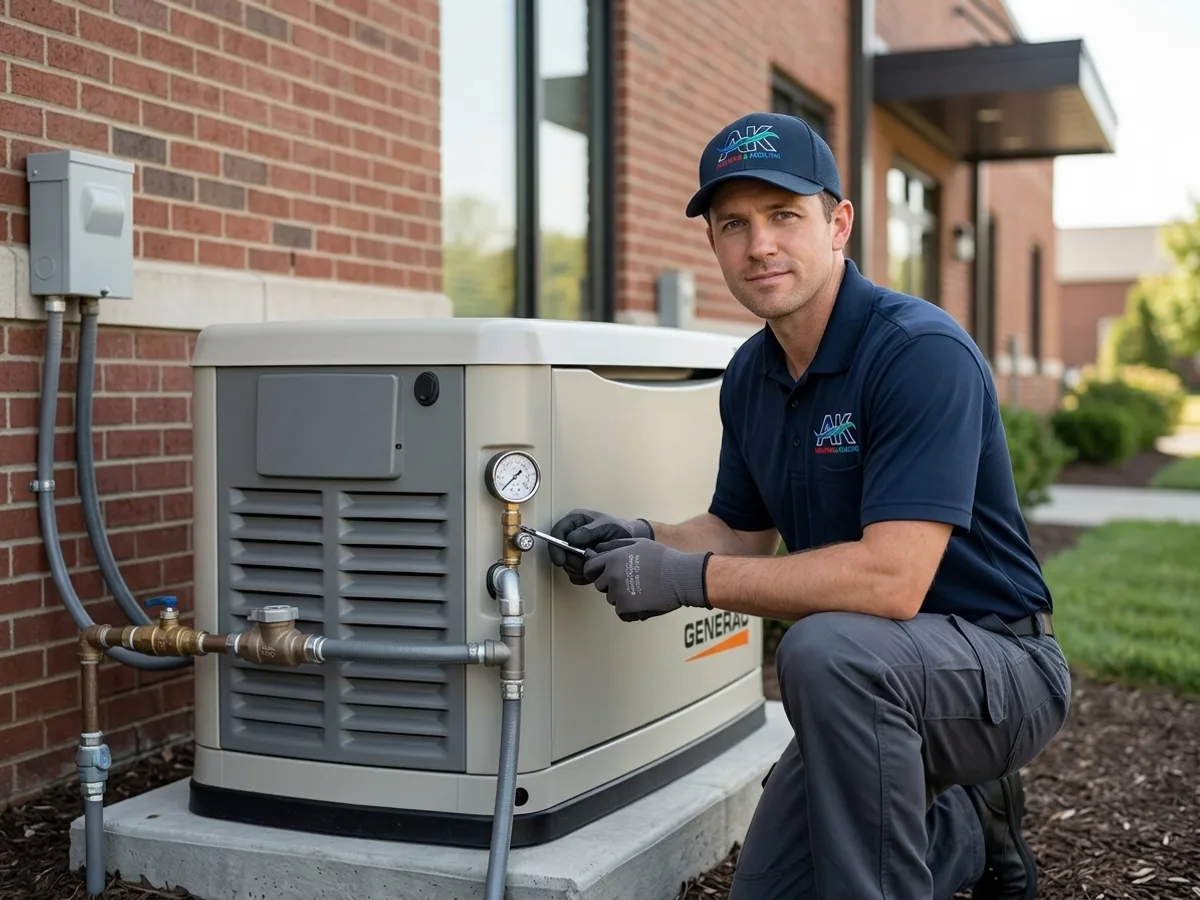
Commercial standby isn't a bigger residential generator. It's a different category of equipment under different code. NFPA 110 governs the system as a whole, NFPA 37 governs the engine and fuel, NFPA 70 (NEC) governs the electrical, and the local AHJ stitches them together at inspection. Walk into a c-store losing pumps for a 3-day outage, a restaurant watching $40,000 of walk-in inventory soften, or a data closet missing its UPS runway - you understand why commercial standby gets engineered differently.
Generac runs two commercial lines: Industrial (true heavy-duty diesel and gas, 25kW to multi-megawatt) and Protector (light commercial liquid-cooled, 22kW to 60kW). AKHC sells, installs, permits, and maintains both across Trumbull, Mahoning, Portage, Ashtabula, and Columbiana counties. Industries we serve regularly: restaurants and food service, multi-tenant retail and office, c-stores and gas stations, healthcare offices, schools, light manufacturing, and food-processing facilities.
Every AKHC commercial install is built around a real electrical load study and AHJ-compliant code package. We handle design coordination, permits, install, commissioning, and the maintenance contract that keeps it warranted.
Commercial standby takes longer than residential - typically 8 to 16 weeks from kickoff to commissioning depending on size, fuel, and permit complexity. Here's how it sequences.
We meet on-site, walk the electrical room, pull load data from your existing service, identify life-safety vs non-life-safety circuits, and define your operating profile - how long do you need to run, what's the worst-case load, what's the redundancy goal. Output is a written load study and recommended unit configuration.
On larger jobs the facility's electrical engineer of record stamps the drawings. AKHC coordinates with the EOR on transfer switch design, fuel system, ventilation for liquid-cooled units, and code-compliance package. On smaller installs we own the design end-to-end.
Written quote with parts, labor, permits, fuel system, and commissioning. Permits pulled through local AHJ - mechanical, electrical, fuel-system, sometimes structural for the pad. Lead time on permits varies by county and project scope.
Concrete pad poured to manufacturer spec and NFPA 37 setback. Fuel system installed - gas line tap with utility coordination, or diesel day-tank with containment. Rough-in electrical to the ATS location.
Unit set on the pad, ATS installed at the service entrance, generator wired to the ATS, low-voltage signal and communications wiring run. Liquid-cooled units get coolant fill and radiator ventilation verification.
Initial start, then a documented load-bank test that proves the unit can carry rated load. Test runs through full operating range and records temperatures, voltages, and frequency under load. AHJ inspector signs off, you get a binder with all commissioning records.
Plenty of contractors sell residential generators. Far fewer can run a NFPA 110 commercial install with paralleled redundancy and AHJ-compliant fuel storage. Here's what AKHC brings.
Factory-trained on Industrial and Protector lines, parts pipeline established, warranty work routed through us. Commercial Generac is its own world and we live in it.
HVAC, refrigeration, and standby power under one roof. On a c-store or restaurant install we cover the cooler hookups, the refrigeration tie-in, and the standby system together. Sister company AK Water Works covers plumbing on grease-trap and fuel-spill containment work where it overlaps.
We pull real load data with a recording meter, not a nameplate-add-up. Right-sized commercial standby is the difference between a unit that handles motor inrush and one that nuisance-trips every time the walk-in compressor kicks on.
Mechanical, electrical, and fuel permits pulled through Trumbull, Mahoning, Portage, Ashtabula, Columbiana, or the relevant city building department. We schedule the inspector and own the punch list.
Annual, semi-annual, or quarterly visits structured to warranty and NFPA 110 documentation requirements. Includes fuel sampling on diesel, battery testing, load-bank test, full report for AHJ. Skipping commercial maintenance voids warranty and fails the next inspection - we don't let that happen.
When a commercial unit faults in an outage, every hour without standby is real money. AKHC dispatches 24/7 year-round. Real techs, real parts on the truck, real accountability.
Questions about your home? We will give you straight answers, no pressure.
Contact usThree things. First, commercial is almost always liquid-cooled (radiator and coolant) instead of air-cooled - higher duty cycle, longer life under load. Second, commercial runs three-phase power to match commercial electrical service, while residential is single-phase. Third, commercial install triggers NFPA 110 (emergency and standby power systems) and stricter NFPA 37 setback rules, plus annual documented maintenance is not optional.
We pull a real electrical load study, not a square-footage estimate. That means panel-by-panel reading of connected load, identifying critical vs non-critical circuits, motor starting kVA for compressors and elevators, future growth factor, and the operating duty cycle you need. For a c-store that has to keep pumps and coolers running, sizing is different than a data center on a 24-hour generator-runtime requirement. We size for real-world worst case.
NFPA 110 governs emergency and standby power systems for life-safety and critical loads. It sets requirements for Type, Class, and Level classification, fuel capacity (Level 1 systems typically require enough fuel for the equipment's classified runtime), weekly no-load exercise, monthly load-bank testing, and annual full-load testing under defined conditions. Documentation requirements are strict - logs must be retained and available for inspection.
Depends on application. Natural gas is preferred for facilities with reliable gas service - no on-site fuel storage, no day-tank, fuel runs as long as the gas main is pressurized. Diesel is required for facilities where gas-supply interruption is part of the risk model (data centers, hospitals) or where local code requires on-site fuel storage for life-safety. Bi-fuel runs primarily on natural gas with diesel backup - useful for extended outages.
Annual at minimum, semi-annual or quarterly for higher-criticality systems. Commercial Generac warranty requires documented annual service. NFPA 110 Level 1 systems require monthly load-bank tests and annual full-load tests. AKHC offers commercial maintenance contracts with scheduled visits, fuel sampling on diesel systems, battery testing, load-bank testing, and full documentation that satisfies AHJ inspection.
Yes. Critical facilities run paralleled generators on common bus duct for N+1 or 2N redundancy. Generac MPS (Modular Power Systems) supports paralleling 25kW to 150kW units; larger industrial systems parallel megawatt-class units. AKHC handles design coordination with the facility's electrical engineer of record - we install and commission, the EOR stamps the drawings.
NFPA 37 governs stationary combustion engines and includes fuel-storage clearances. Diesel tanks over 660 gallons trigger additional EPA SPCC (Spill Prevention) requirements. Above-ground diesel storage needs containment, leak detection on day-tanks above certain thresholds, and proper venting. We design the fuel system to code and coordinate inspection.
Same-day dispatch from our Warren shop across five counties.
“Furnace went out on a Sunday night. AK had a tech in the driveway in 90 minutes, parts on the truck, and we were warm before kids' bedtime. Worth every dollar of the maintenance plan.”
“Our restaurant walk-in went down at 6am. AK answered the after-hours line on the second ring and had us running before lunch service. We've switched all of our refrigeration work to them.”
“Had Generac install, AC tune-up, and a humidifier swap done across two visits. One bill, one company, real techs. This is what local service is supposed to feel like.”

Generac commercial warranty terms require annual documented service from a qualified servicer. NFPA 110 Level 1 systems require monthly load-bank tests and an annual full-load test logged for AHJ review. Skip either and you've got an expensive piece of equipment with no warranty backing it and a code violation on your next inspection. Lock in a maintenance contract at install - it's the only way commercial standby actually works the way you bought it to work.
Three Alex Mantalis companies, one Warren HQ. Each with its own license and insurance — coordinated when you need more than one trade.
Plumbing, Drains, Waterproofing
Visit site →HVAC, Refrigeration & Generators
You are hereFire, Water & Mold Restoration
Visit site →