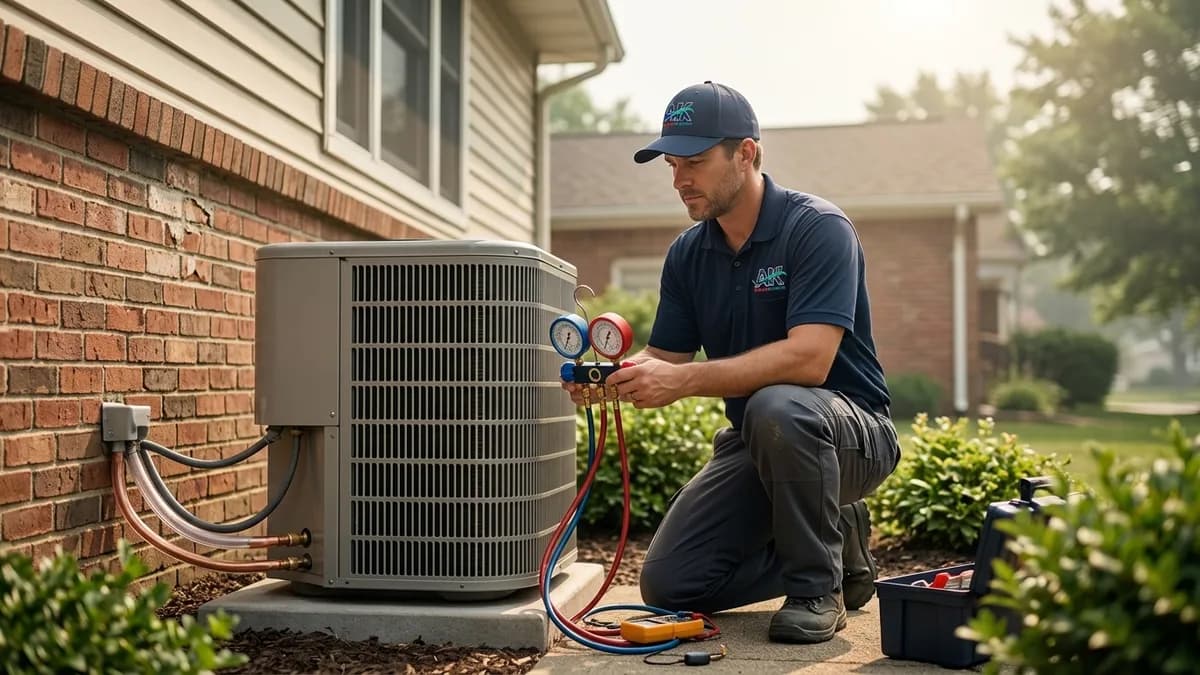
If your air conditioner is 15 years old and you are staring down another repair bill, the question is fair and urgent: do you fix it again, or do you replace it? The honest answer is that 15 years is right at the edge of when replacement usually makes more financial sense than repair, but the right call depends on a few specific factors. This article walks through every one of them so you can decide with confidence, not pressure.
Most 15-year-old air conditioners are near or past their useful life. If the repair costs more than half the price of a new system, if your energy bills have been climbing, or if the system has needed multiple repairs in recent years, replacement is almost always the smarter long-term investment.
What 15 Years Actually Means for an Air Conditioner
The typical lifespan of a central air conditioner is 15 to 20 years with proper maintenance. That means your 15-year-old system is not automatically dead, but it has entered the phase where wear accumulates fast. Key components like the compressor, capacitors, and refrigerant lines have been cycling through heat and cold for a decade and a half. Even a well-maintained system at this age is running closer to its failure window than its prime years. A system that was never serviced regularly may already be running on borrowed time.
Age alone is not the only signal, but it is the starting point for every honest repair-or-replace conversation. At 15 years, you are no longer asking whether the system will eventually fail. You are asking how soon and how much it will cost you before it does.
The Real Cost Comparison: Repair vs. Replace
The most practical tool for this decision is sometimes called the 5,000 rule: multiply the age of the system by the estimated repair cost. If that number exceeds 5,000, replacement is typically the better value. For a 15-year-old system, any repair costing more than roughly $333 triggers that threshold. That is a low bar, and many common repairs such as compressor work, refrigerant recharge, or coil replacement can easily run $800 to $2,500 or more.
Beyond the repair bill itself, there is the question of what you get for that money. A repair on a 15-year-old system buys you more time on an aging unit, not a renewed system. A replacement, by contrast, comes with a manufacturer warranty, modern efficiency, and a fresh 15-to-20-year clock. When you frame it that way, paying a significant repair cost on an old system often means spending serious money to delay an inevitable replacement by only a year or two.
The Efficiency Gap: What Your Old System Is Costing You Every Month
Air conditioners manufactured 15 years ago were built to meet the efficiency standards of that era. Modern systems are significantly more efficient, measured in SEER2 ratings. An older system may operate at an efficiency level that current entry-level units surpass by a wide margin. That gap shows up directly in your monthly electric bill every summer. Over a full cooling season in northeast Ohio, the difference in operating costs between an aging low-efficiency system and a modern unit can be meaningful enough to offset a portion of the replacement cost over several years.
The efficiency loss compounds as a system ages. Worn components, refrigerant that is slightly low, and degraded insulation all cause the system to run longer to achieve the same cooling. You may not notice the gradual increase month to month, but comparing your current summer bills to those from five or six years ago often tells the story clearly.
Parts and Warranties: The Quiet Problem at Year 15
Manufacturer warranties on residential air conditioners typically run 5 to 10 years on parts and sometimes longer on compressors when registered properly. At 15 years, any warranty coverage that existed is almost certainly expired. That means every repair comes entirely out of pocket, with no manufacturer support behind it.
There is also a practical parts challenge. As systems age, certain components become harder to source. Refrigerants used in older systems have been phased out under federal environmental regulations, which makes servicing those systems more expensive and, eventually, impossible. If your 15-year-old system uses R-22 refrigerant, you are already in a situation where recharging it costs significantly more than it once did because the supply is restricted. That is a built-in reason the math on repeated repairs gets worse over time, not better.
Summer Breakdown Odds: Why August Is the Worst Time to Wait
Air conditioners fail most often during peak demand, which in Warren, Ohio means the hottest stretches of July and August. This is not a coincidence. The system is working hardest precisely when its worn components are under the most stress. A 15-year-old unit running at full capacity on a hot summer afternoon is carrying the highest failure risk it will face all year.
An emergency breakdown in peak summer means emergency service rates, potential delays waiting for available technicians, and sometimes days without cooling while parts are ordered. A proactive decision made now, while the system is still running, gives you time to compare options, schedule on your terms, and avoid all of that. Waiting is not neutral. It trades a planned decision for an emergency one.
Five Signs Your 15-Year-Old AC Is Telling You Something
Beyond age and cost calculations, the system itself often signals when it is running out of reliable life. Pay attention to these warning signs.
- Rising energy bills with no change in usage habits or summer temperatures, which usually points to declining system efficiency.
- Uneven cooling across rooms, where some areas stay comfortable while others stay warm no matter how long the system runs.
- Strange noises such as grinding, rattling, or banging, which often indicate worn mechanical components inside the unit.
- Weak airflow from vents, which can signal a failing blower motor, clogged coils, or duct problems aggravated by years of use.
- Frequent refrigerant leaks or the need for repeated recharging, which suggests the system has developing cracks or joint failures that are unlikely to be a one-time fix.
What the Team at AK Would Do With a 15-Year-Old System
At AK Heating and Cooling in Warren, Ohio, the approach to this question is straightforward: tell you what you actually need, not what generates the bigger service call. If a repair makes clear financial sense and will buy you real, reliable life on a system that has been well maintained, we say repair. If the numbers point toward replacement, we say so, even if that means a longer conversation and a bigger decision for you.
Jack, the apricot poodle who keeps the AK office company, cannot diagnose your compressor. But the humans here can give you a straight answer after a real assessment of your system. One call gets you an honest evaluation, not a pitch. That is the only way we know how to operate.
As a family-owned company running plumbing, heating, and cooling under one roof, AK has no incentive to steer you wrong on one trade to protect another. The business only works if you trust us with your home for years, not just one visit.
The Bottom Line
A 15-year-old air conditioner sitting in an Ohio summer is at a genuine decision point. The age, the efficiency loss, the parts and warranty reality, and the peak-season breakdown risk all point in the same direction for most homeowners: a careful, honest look at whether continued repair still makes financial sense. For many systems at this age, it does not. For some that have been well maintained and need only a minor fix, it might. The only way to know is a real assessment from someone who will give you the straight answer.