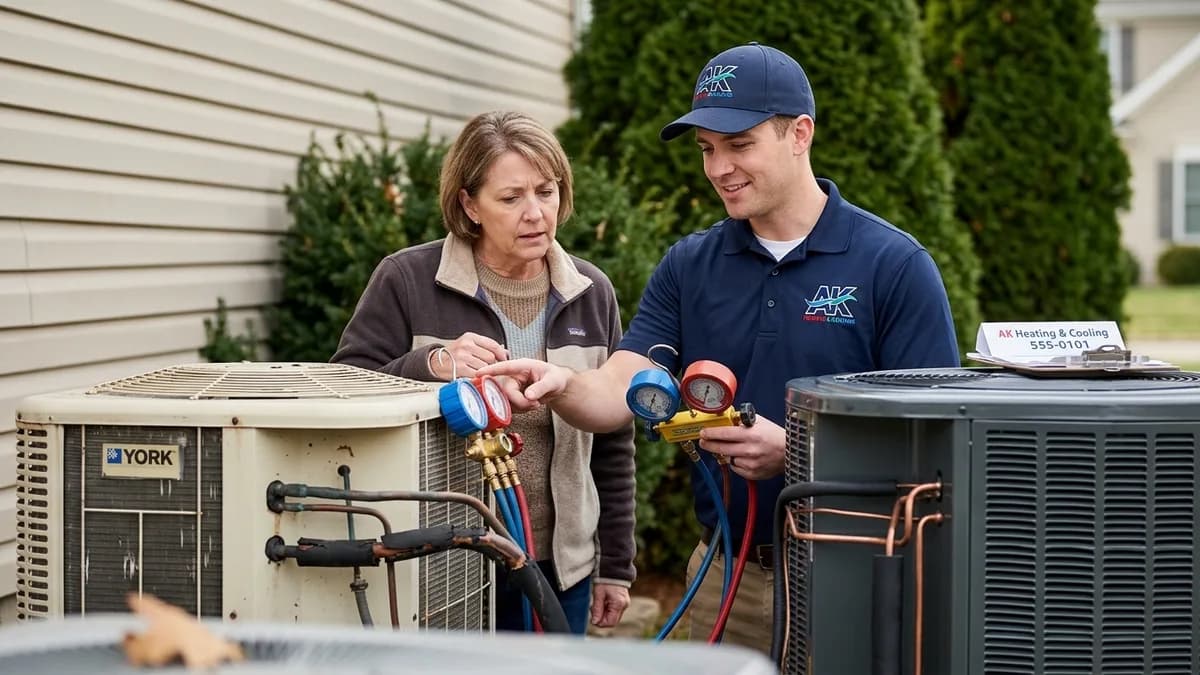
If you're planning to replace your air conditioner or heat pump in 2026, you've probably heard that R-410A — the refrigerant in most systems installed over the last 15 years — is "going away." That's true, but the details matter, and the EPA just changed one of the most important ones. Here's the plain-English version for Northeast Ohio homeowners, plus what it means for your decision and your wallet.
The short version: New AC and heat pump systems now use lower-emission refrigerants (R-454B or R-32) instead of R-410A. Your existing R-410A system is fine — it can still be repaired and recharged. And a new EPA final rule, effective July 27, 2026, removed the hard installation cutoff for older R-410A equipment, so there's a little more flexibility than the headlines suggested.
What the AIM Act actually did
The whole shift traces back to the American Innovation and Manufacturing (AIM) Act of 2020, which directs the EPA to phase down hydrofluorocarbons (HFCs) — the class of refrigerants R-410A belongs to. Under the EPA's Technology Transitions Rule, new residential AC and heat pump equipment has to use a refrigerant with a global warming potential (GWP) under 700.
R-410A has a GWP around 2,088, so it doesn't make the cut. As of January 1, 2025, manufacturers stopped building and importing residential split systems that run on R-410A. That's the real "phase-out" line in the sand: it's about the equipment, not an overnight ban on the refrigerant itself.
Meet the replacements: R-454B and R-32
Two refrigerants have taken R-410A's place on nearly every spec sheet:
- R-454B — GWP of about 466. Common in ducted central systems.
- R-32 — GWP of about 675. Often used in mini-splits and ductless systems.
Both are classified as A2L, which means "mildly flammable." In practice that's not something a homeowner needs to worry about — A2L systems are engineered with leak detection and other safety features built in, and they've been used safely in other parts of the world for years. What it does mean is that A2L equipment needs a contractor who's trained and equipped for it, with the right tools and installation practices.
One thing worth knowing in Northeast Ohio: which refrigerant you end up with usually depends on the equipment brand you choose, not the other way around. We install and service all major brands, so we'll match you to the right system for your home rather than steer you toward one refrigerant.
The deadline that just changed: EPA's 2026 final rule
This is the part that's caused the most confusion. The original plan set January 1, 2026 as the deadline to install any remaining R-410A equipment that was manufactured before 2025. A lot of homeowners read that as "R-410A is illegal in 2026" — which was never quite right, and is now even less so.
In 2026 the EPA finalized a rule, effective July 27, 2026, that removes that hard installation cutoff. Pre-2025 R-410A systems can continue to be installed until existing supplies are used up, rather than being stranded on a shelf after a fixed date. For most Ohio homeowners this is a non-event — by the time you're shopping, new equipment is overwhelmingly A2L anyway — but it does take the panic out of the calendar.
(A few states, like New York, wrote the original 2026 deadline into their own law. Ohio did not, so the federal final rule is what applies here.)
What this means if you're replacing your AC in 2026
Here's the honest breakdown for a homeowner in Warren, Youngstown, Boardman, or anywhere else we serve:
- A new system you buy now is almost certainly A2L. If you're replacing your whole AC or heat pump in 2026, you'll most likely get an R-454B or R-32 system. That's a good thing — it's current technology that won't be obsolete next year.
- Your existing R-410A system is not in trouble. Nothing about the phase-out forces you to replace a working unit. R-410A can still be bought, sold, and used to service the systems already in homes.
- R-410A service will get more expensive over time. Production of R-410A is scheduled to keep shrinking — down to roughly 15% of current output by 2036. As supply tightens, the price to recharge an older system after a leak will climb. That's the real cost pressure to plan around, not a ban.
Will my current R-410A system stop working? No.
If your AC is running fine, the phase-out doesn't change anything for you today. You can keep it, maintain it, and repair it. The decision point only arrives when a major repair comes up — a failed compressor or a significant refrigerant leak — and you're weighing "fix the old one" against "replace it." As R-410A gets pricier, that math tilts toward replacement a little sooner than it used to, especially on systems already 12 to 15 years old.
How to make a smart replacement decision
- Don't panic-buy on a deadline. The calendar pressure people felt about 2026 has largely eased. Replace when your system or your budget says it's time, not because of a date.
- Get a proper load calculation. Right-sizing matters more than refrigerant. An oversized system short-cycles and struggles with humidity; an undersized one runs nonstop. Insist on a real sizing assessment, not a "same size as the old one" guess.
- Ask what refrigerant the system uses and whether your installer is A2L-trained. A2L equipment is straightforward to install correctly — when the crew is set up for it.
- Factor in efficiency, not just price. Newer systems meet updated SEER2 efficiency standards, which can lower your summer bills. Ask for the efficiency rating alongside the quote.
- Ask about available utility rebates. Heat pumps in particular may qualify. Programs change, so confirm what's current at the time you buy.
Talk to a local team that already works with A2L
AK Heating & Cooling installs and services every major HVAC brand across Trumbull, Mahoning, Portage, Ashtabula, and Columbiana counties — and we're set up for the new A2L refrigerants. Whether you want to keep your current R-410A system running a few more seasons or you're ready to plan a replacement, we'll give you a straight answer about repair versus replace, the right size for your home, and what it'll cost.
See our residential heating and cooling services, check whether we serve your town, or contact AK Heating & Cooling. You can also reach us anytime at (330) 469-6701 — we're family-owned, local, and available 24/7 for emergencies.
Frequently asked questions
Is R-410A banned in 2026?
No. Manufacturers stopped building new R-410A residential systems as of January 1, 2025, but the refrigerant itself is not banned. It can still be sold and used to service existing systems, and the EPA's 2026 final rule even removed the hard deadline for installing older R-410A equipment that was already made.
Can I still get my R-410A air conditioner repaired?
Yes. Existing R-410A systems can be repaired, recharged, and maintained for years to come. The main change is cost: as R-410A production winds down, recharging after a leak will gradually get more expensive, which is worth keeping in mind for older units.
Are the new A2L refrigerants safe?
Yes. R-454B and R-32 are classified A2L, or "mildly flammable," but the equipment is engineered with leak detection and safety features to account for that, and these refrigerants have a long track record internationally. The practical requirement is that your installer is trained and equipped for A2L systems.
Should I replace my AC now or wait?
If your system is working well, there's no urgency from the phase-out alone. The time to consider replacing is when you're facing a major repair on an aging system. As R-410A gets pricier, replacing a 12-to-15-year-old unit often makes more sense than pouring money into it.
Will an A2L system cost more than my old one?
New equipment pricing reflects current technology and updated efficiency standards, so quotes can run higher than a like-for-like swap from a few years ago. The upside is better efficiency, which can offset some of that on your energy bills. We'll walk you through the numbers before you commit.